Community engagement for the public sector
Residents ask in their own words.
You see where the need is.
Atlas by Cordata Civic answers in plain language, in any language, and returns anonymized data your departments can plan with.
Anonymous by design — we measure the need, never the name.
Atlas InSites is now Cordata Civic. Read about the name change
Meet Atlas
Barrier reporting and local information, all in one place
Atlas is the assistant residents talk to. They speak to Atlas in their own language, and Atlas answers in plain language using grounded information from its database. Atlas can direct the user to the website, number, or office they need.
Every resident, every channel
The same answers, however a resident reaches you
One service directory, one set of answers, four ways in. A resident over the phone gets the same answer as a resident using the embedded widget, because it comes from the same published record.
Want a demo? Get in contact. We will show you the platform, and you can try Atlas for yourself to see how it works.
Arrange a demoEvery channel is optional. Opt in to whatever you need.
On your website, or ours
A standalone page residents can be linked to from wherever. White-labelled on your domain, or hosted standalone on one of ours.
A link. Nothing to install.
Embedded in the site you already have
One HTML script tag on your existing CMS. Atlas answers in place without a redesign or any extra setup.
One embed snippet, added with one line of code.
Over the phone or SMS
Residents can call or text our toll-free number (1‑844‑ATLASBC), or you can have a custom number provisioned for your residents specifically.
We provision the line; you publish the number.
At a kiosk
Library and city-hall kiosks for anyone who needs them. We’ll handle the setup, you see the results.
Custom solutions available on request.
What you get back
Questions become evidence you can plan against
Every question a resident asks is a signal about what your community needs and cannot find. Your dashboard shows fully anonymized barrier reports, most-asked-about resources, service gaps, and more. Atlas Planner uses this aggregated information to generate reports, write grant proposals, and find patterns in the data.
What your community is asking for
Summarized and stripped of all PII. Your dashboard shows you the real, useful signals hidden within the questions your residents ask Atlas.
- Analytics: see how people use Atlas — which channels, in what languages, and how often.
- Barrier Reports: anonymous, geo-tagged barrier reports, so you know exactly where issues are.
- Community Needs: see what questions Atlas can’t answer, and in turn where service gaps exist.
The report, already written
Atlas Planner can dig into your data and find patterns. Then it can write you reports, create surveys, draft grant proposals, and more.
- Create: draft grant proposals, create surveys, write council packages, generate visualizations, and more.
- Analyze: find hidden patterns in the data, see how queries change over time, and pull out trends over the last month.
- Audit: Atlas Planner can work with you to triage through community needs and create actionable plans.
Sourced, not invented
Answers grounded in truth
Atlas responds with knowledge from its database — a database that contains human-verified information, and that you have full control over. Atlas is built never to invent, but to be honest when it doesn’t know.
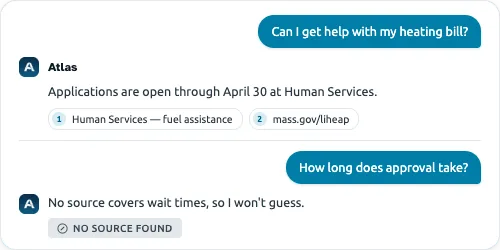
One knowledgebase, grounded in truth
Your programs, services, bylaws, locations, contacts, and more, all manually verified and built at onboarding. Then, Atlas’s knowledgebase is refreshed automatically from authoritative sources, and fully editable in your dashboard.
It’s honest when it doesn’t know
“Not in the directory” is a state Atlas can recognize, not a gap it fills with a plausible guess. Unanswered questions route to someone who knows, then show up in the dashboard as a service gap.
Every answer traces back to a record
Staff can see which published record produced an answer. If something is wrong, the fix is simply editing that record.
Your staff control what changes
Records are approved by your staff before Atlas goes live. Then, your staff have full control over them.
Accessible-first and Canadian
Built for privacy and accessibility first
We believe everybody who wants to use Atlas should get to. Atlas is built to be accessible for all users, including those without an internet connection or a mobile phone. We also believe users are entitled to complete privacy, meaning all data we collect is completely anonymized and aggregated.
Our methodology
Accessible infrastructure
The Atlas platform is accessible in more ways than just in code. We offer a phone service for residents who are less technically inclined or who struggle with literacy. Every channel is available in 40+ languages, ensuring all information is available for everyone.
Tested on every change
Accessibility checks are performed before we release any changes. Our checks include colour contrast, ARIA roles and labels, keyboard focus visibility, target sizing, heading and landmark structure, reflow at 400% zoom, text-spacing resilience, reduced-motion behaviour, and HTML validity.
Anonymous by design
No sign-up is required for a resident to use Atlas. They simply click the link and use it. This means we never collect any information such as names or email addresses. Every message is stripped of all personally identifiable information, then summarized before being reported.
Privacy is not a setting
Data anonymization is always on. Any feature regarding privacy is non-changeable, meaning every deployment of Atlas is privacy-first, no matter where.
Compliance
WCAG 2.2 level AA and EN 301 549 v4.1.1
We build to and test against WCAG 2.2 level AA, as outlined by EN 301 549 v4.1.1. Importantly, we have not yet had an independent WCAG 2.2 AA audit, nor do we claim to be WCAG 2.2 AA compliant. We build using it as a guideline to our best effort.
Retention and data deletion
Data deletion is available on request by sending your session ID to support@cordataintelligence.com. If you interacted with Atlas over the phone (voice or text), we require your phone number instead of a session ID. Data retention policies are set by the municipality during onboarding.
BC FIPPA and PIPEDA
We work to meet BC FIPPA and PIPEDA wherever possible. This includes adjustable data retention policies, as well as Canadian data residency for paying municipalities.
Canadian data residency
Resident data stays in Canada. Retention windows are yours to set, and yours to shorten. Note: for municipalities performing unpaid pilots of the Atlas platform we do not claim Canadian data residency.
Documentation
Four steps, roughly four weeks
01
Onboarding
We work with your team to create a plan to deploy Atlas in your community in a way that meets your needs. Then, we curate the knowledgebase Atlas runs on, manually reviewing every entry. Finally, you review the knowledgebase and try out Atlas before it goes live.
02
Releasing
When ready, Atlas goes live on your site, by SMS and phone, and kiosks are deployed if applicable. Our team closely monitors the system to ensure everything is working as expected and users are getting genuinely helpful answers.
03
Letting it run
Once Atlas is deployed and verified, it can be left alone. Any technical maintenance required will be handled by our team, so you can just let it run. Over the course of the first couple of weeks the signals will begin coming in.
04
Plan against real demand
Once Atlas has been used for some time, your dashboard will contain real barrier reports, community needs, and signals you can begin using in your planning.
Proof you can check
Try it yourself
Try out our public demonstrations of Atlas. We use a fictional town called Maplewood, with a database of plausible but purely fictional data to demonstrate how Atlas works.
Standalone
Atlas on a page of its own
Embedded
Atlas inside a municipal site
Phone
Atlas over the phone
Name change
Atlas InSites is now Cordata Civic
The company changed its name; nothing about your deployment did. Atlas remains the assistant residents talk to — now Atlas by Cordata Civic. Over the coming weeks our website will move to cordatacivic.com and away from atlasinsites.com.
Old URLs will redirect to the new ones, so no existing links will break as we migrate. If you would like more information about the name change, write to support@cordataintelligence.com.
Contact
Questions are always welcome
We work directly with municipalities to ensure Atlas meets your specifications. Write to us to set up a call so we can discuss how Atlas can fit your community’s needs, or to see a demonstration of the dashboard and Atlas Planner.
- General enquiries
- hello@cordataintelligence.com